"The Cow Kicked It Over"
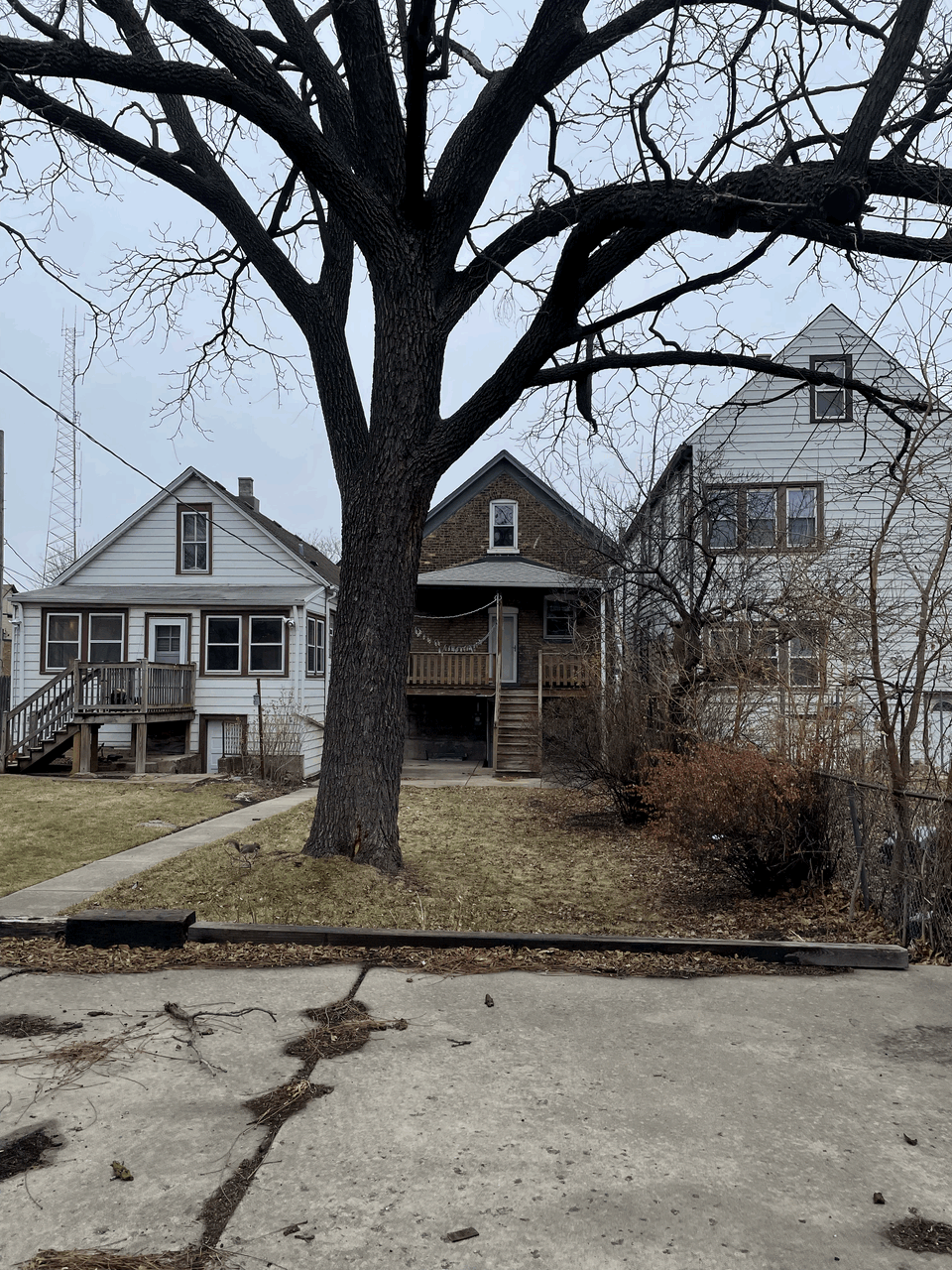
My introduction to the Chicago fire came with a tune. It was a nursery rhyme, a catchy and now-classic piece of Americana that made misfortune into melody. For generations, the story of Mrs. O’Leary’s cow has rung through classrooms, around campfires, and in children’s books: a lantern, a cow, a wink, a fire. But behind that tune is a raucous reality. The Great Chicago Fire of 1871 was not caused by a cow, but rather the result of a city built like kindling, fought by scarce and overworked firemen, and governed by a civic leadership unaware of its fragility. The fire exposed deep flaws in Chicago’s infrastructure, social attitudes, and leadership, and in the end reshaped the city through aggressive reconstruction and modernization.
Chicago was a wooden wonderland in 1871. Two-thirds of its buildings were made of timber, while the rest wore wooden shingles and were hemmed by wooden sidewalks, barns, and outhouses. That summer had been unusually dry. Boards were brittle and the air had been thick with sawdust. Even the river had been known to ignite in flames due to leaky chemical barges, exposing an environmental ignorance. But the fire’s greatest and most devastating weapon was strong winds from the southwest.
The city’s firefighters, valiant but overburdened, totaled only 185, for a population of over 300,000, inside 3.3 square miles. They had just battled a major fire the night before. Just seventeen horse-drawn steam engines were all that stood between order and inferno. Their communication systems were rudimentary, where order and alarms had failed, confusion held the reigns. When the fire broke out in the O’Leary barn, the city’s fire department was too weary and too poorly equipped to stop what would become a cataclysm. Chicago’s inflammable architecture, drought conditions, and inadequate services had already written the prelude—the cow, if she existed at all, was just the period (or exclamation point!) at the end of the story.
On that fateful night, October 8, 1871, at around 9 p.m., flames swallowed up the O’Leary barn. In only minutes, they spread to neighboring homes, sheds, and barns. The wind turned the blaze into an unleashed predator, devouring block after block. Eyewitnesses described the sky as glowing orange and the heat so intense paint blistered on buildings just in vicinity. Families fled with children in arms, carrying whatever they could, only to watch their city and life’s possessions turn to ash behind them. By dawn, the fire had hurdled the Chicago River, its embers carried on the wind and its fuel riding the wave. When the city’s pumping station itself caught fire, the water pressure vanished entirely. They were defenseless.
The legend of Mrs. O’Leary’s cow began almost immediately. Michael Ahern, a reporter for the Chicago Tribune, admitted later to inventing the story to entertain readers. But it stuck, like soot in public memory. The cow made for a tidy antagonist while the truth was a bureaucratic pigsty.
Importantly, Catherine O’Leary was an Irish immigrant—a convenient scapegoat when anti-Irish sentiment ran red-hot in post-Civil War America. Her accent, her poverty, her position made her the perfect vessel for collective guilt. When questioned, she denied everything, as if to say, “It is not my cow, it’s not my barn.” An official inquiry found no evidence of her guilt. However, it was not until 1997— 126 years later, that she was officially and publicly exonerated.
The devastation from the fire was biblical. Over 17,500 buildings were in ruins. And more than 100,000 people were simultaneously made homeless. Entire neighborhoods were cleared. Insurance companies collapsed under the weight of claims, refusing payment to many. The poorest districts, where immigrants lived, suffered most. Wooden cottages and crowded tenements were gone overnight. The news fanned the flames of resentment, printing moralistic tales, and nailing the poor, the drunk, and the foreign at stake for the city’s sins. Rumors of looting and crime permeated public perception. Morale and trust were at an all-time low.
Yet, out of disaster came something kind of remarkable. The response, while at first chaotic, became one of the first major humanitarian operations in American history. The newly-formed American Red Cross organized relief for the displaced. The U.S. Army set up tent cities in the parks. Food, water, and clothing poured in from across the country. Civic leaders drafted new building codes, banning wooden construction in the city center and requiring brick or stone in its place. Streets were widened. The water system was redesigned. Architects saw the city as a blank slate, among them famously, Daniel Burnham. From this destruction ascended a new architectural age, one marked by steel frames and ambition; the modern skyscraper, as the trophy of their comeback.
Economically, the fire could have crippled Chicago, but it did the very opposite. They spun the catastrophe into a tale of resilience. “Chicago shall rise again,” was the slogan, and rise it did, in record time. Within a decade, the city’s population had outdone its pre-fire numbers. Railroads, stockyards, and factories multiplied. The fire became a strange kind of civic myth. And the phoenix became their emblem.
Still, the myth of the cow endured. It appeared in textbooks, songs, and stories, long after Catherine O’Leary was gone. The competition was rigged for which story would stick; one of zoning failures and corrupt city councils or one about a naughty cow with a lantern. The same mechanism of simplifying tragedy by personalizing blame has echoed through history. After Hurricane Katrina, it was “those who should have evacuated.” After the Grenfell Tower fire, it was “those who ignored safety advice.” Scapegoats make disaster palatable.
The Chicago Fire was not the fault of a cow or a woman but the failure of a city that built itself of wood and ignored the wind. Out of pebbles, Chicago learned, adapted, and transformed into a model of modern urban resilience. The skyline that now defines the city, towers of glass and steel, stand as monuments not just to architecture, but to accountability. Progress without foresight can crumble quickly, and better building takes more than bricks.
“One dark night when we were all in bed, Mrs. O’Leary left a lantern in the shed, and when the cow kicked it over she winked her eye and said, ‘It’s gonna be a hot one in the old town tonight.’ Fire! Fire! Fire!”